
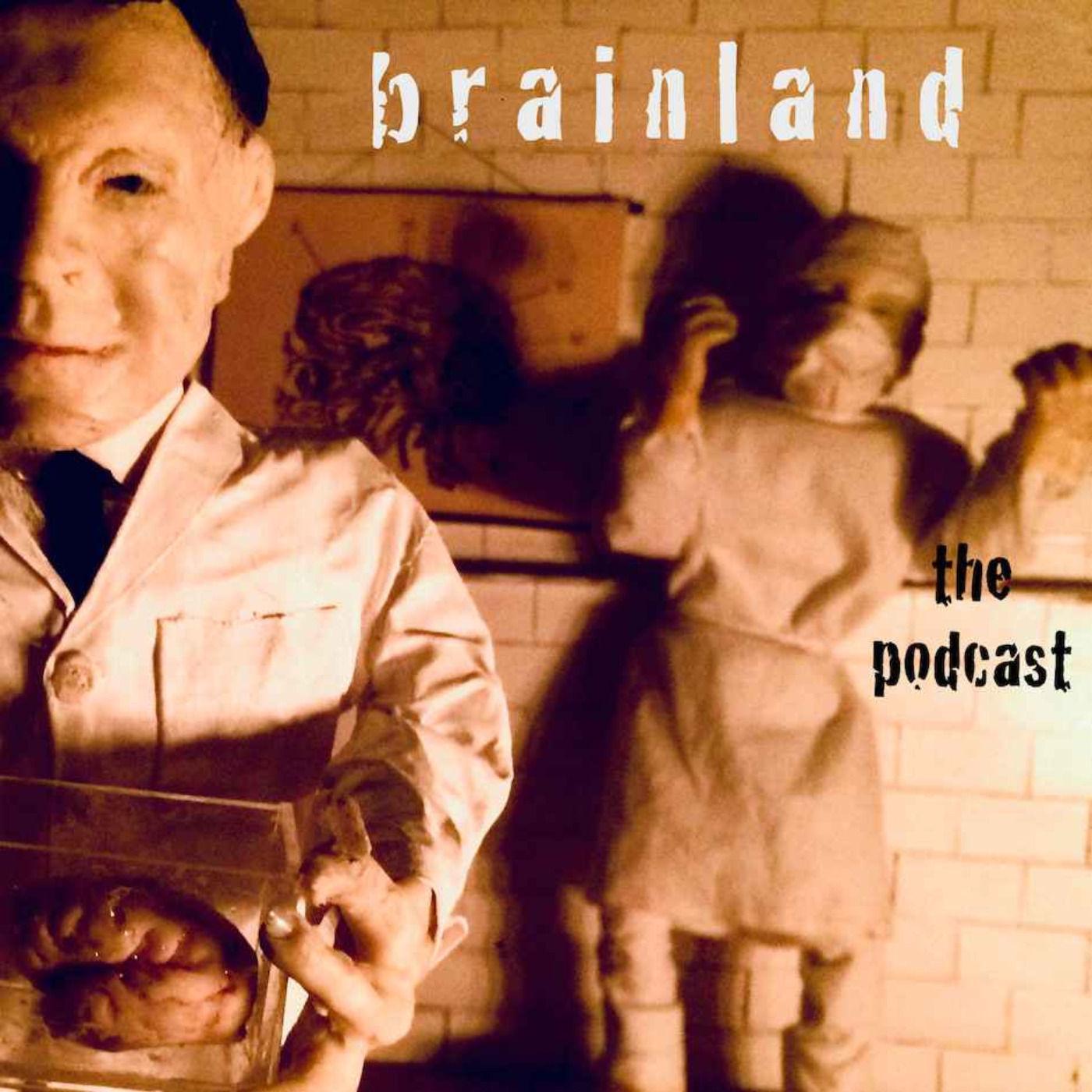
BRAINLAND
Brainland the podcast navigates the boundary between neuroscience, the arts and humanities with the occasional wander off piste. It began as a neuro-historical exploration of the background to the Brainland the opera but quickly spread its wings. A Brainland Collective production. Hosted on Acast. See acast.com/privacy for more information.
Pick up right where you left off
- Resume on any device
- Progress saved on every episode
- Plus every other Pro feature
From €2.49/month
Episodes
Showing the latest 75 episodes of this show.
THE MATCHBOX GIRL: Recreating Hans Asperger's world in fiction
Mar 19, 2026 · 47m
Resume with ProIn this episode novelist and playwright Alice Jolly talks about her latest novel, 'The Matchbox Girl'' about a neurodiverse girl and then young woman who is referred to Asperger's clinic in Vienna in the 1930s. Alice talks about her decision to use a female patient/narrator and how the book 'felt like a radio you couldn't properly tune in' until she found Adelheid, her narrator's voice. We...
HANS ASPERGER AND THE AUTISTIC SPECTRUM: Reflections on the past, present and future
Mar 6, 2026 · 42m
Resume with ProFor the first episode of season 3 your host travelled to North London to record a conversation with Dame Uta Frith whose translation of Hans Asperger’s now famous paper was published 35 years ago. After discussing her reasons for moving to the UK, Uta talks about Lorna Wing’s work and influence before discussing the innovative and multidisciplinary clinic in which...
SEASON 2 FINALE: Surfing Brainland
Feb 7, 2026 · 30m
Resume with ProThe final episode of season 2 is a compilation of 10 male and 10 female voices from season two, chosen more or less at random, about 90 seconds from each episode sampled at or around 20 minutes in. Thanks to all guests for a fascinating season and see you in season 3. The key to the episodes and timings is below: 1.10. Kimberly Campanello.(26) DANTE, DOPAMINE AND ME: Neuro-poetic and other...
FRANKENSTEIN DISASSEMBLED: The remarkable life of Mary Shelley.
Feb 2, 2026 · 1h 8m
Fiona Sampson's probing biography of Mary Shelley is the first of a trilogy of biographies of 19th century writers of the romantic period. After sharing her approach to biography, Fiona talks about Mary's famous parents: Mary Wollstonecraft, influential philosopher and educator, who died of puerpural fever shortly after Mary's birth, and William Godwin and radical philosopher. We discuss the...
DISCOVERING EISENSTEIN: Part 2 - Neuroscientific collaborations.
Jan 29, 2026 · 48m
Soviet era film director and theorist Sergei Eisenstein began collaborating with Alexander Luria and Lev Vigotsky, key figures in neuropsychology and developmental psychology, in 1925, the year he released his most famous film, Battleship Potemkin. Julia Vassilieva, after studying psychology in Moscow, got the opportunity to study the papers of Luria and Vigotsky, both of whom had a long term...
DISCOVERING EISENSTEIN: Part 1 - Life and films.
Jan 21, 2026 · 1h 0m
This is the first of two episodes on the life, work and collaborations of Soviet film director and theorist Sergei Eisenstein. Ian Christie has researched and written about Eisenstein for more than 40 years. In this wide ranging conversation, we talk about the influence of his troubled childhood, the importance of drawing throughout his life, the international fame that resulted from his second...
AN ARTIFICIAL HISTORY OF NATURAL INTELLIGENCE: Time travelling the mind.
Jan 17, 2026 · 48m
In this episode David Bates discusses his recent book An Artificial History of Natural Intelligence: Thinking with machines from Decartes to the digital age', a masterly survey of the history of intelligence and its aids. The book is the summation of 20 years of scholarship, a kind of time travel of the mind, and the range of topics we cherry-pick include the influence of automata on Descartes's...
WILLIAM SARGANT AND HIS 'SLEEP ROOM': Shrinks, spooks and medical hubris.
Jan 14, 2026 · 59m
In this podcast novelist and journalist Jon Stock discusses his latest book 'The Sleep Room: A very British Medical scandal', is a factual account of psychiatrist William Sargant (1907-88 ) that focusses particularly on Sargant's controversial 20 year 'sleep room' regimen for mental illness that combined continuous narcosis, high dose mixed antidepressants, major tranquillisers and ECT, sometimes...
MANHANDLING THE BRAIN: How did damaging the brains of the mentally ill ever seem a good idea?
Dec 28, 2025 · 38m
In this festive episode Ken reads 'Manhandling the Brain', his essay on the origins of mid-20th century psychosurgery, an attempt to understand how, for over 20 years, so many people thought it such a good idea to damage the brains of the severely mentally ill and the lessons that can be learned. Participants: Ken Barrett, visual artist, writer and retired neuropsychiatrist...
THE HORROR! The anatomy of fear in film.
Dec 18, 2025 · 53m
In this episode film critic/writer Matt Glasby and artist Barney Bodoano discuss their innovative book on horror movies 'The Book of Horror: The anatomy of fear in film'. After talking about their gateway into their horror obsession Matt takes us through his seven 'scare tactics', techniques used by film makers to evoke shock, dread, revulsion etc. including specifically filmic techniques such as...
HORROR ON THE BRAIN: The neuroscience behind sci fi and horror.
Dec 11, 2025 · 44m
Austin Lim's book 'Horror and the Brain' uses work from the horror and science fiction genres as a way into discussing a neuroscience and a range of related stories. We discuss why on earth so many people inflict the feelings provoked by horror fiction on themselves ans talk about a range of brain structures that play a role in fear, emotion and attachment behaviour (with a diversion into love...
DREAM WARRIORS: Exploring the world of the surrealists...
Dec 5, 2025 · 47m
In 1924 French poet Andre Breton wrote that ‘Surrealism is based on the belief in the omnipotence of dreams, in the undirected play of thought’. Surrealism grew out of the anarchistic DaDa movement triggered by the carnage of WW and was fueled by Freud's writing on the unconscious. Roland Penrose was a leading surrealist artist and also a key figure in bringing the movement to the UK in the 1930s...
DREAMWORKS: Fellini's dream obsession, from graphic diaries to movies.
Dec 1, 2025 · 54m
Frank Burke is a leading film scholar with a long interest in Italian director Federico Fellini (1920-1993). Few artists were more obsessed with their dreams than Fellini. In this conversation we talk about his early interest in puppets and circus, and his jobs, before moving into film, as an illustrator and caracaturist. Drawing was always an important part of his preparation for movies but he...
'...PERCHANCE TO DREAM: On the neuroscience of sleep and dreaming...
Nov 27, 2025 · 59m
In this wide ranging conversation Mark Solms talks about his seminal research in the '80s on the effect of brain lesions on patient reports of dreaming. After a brief visit to Charcot and Wilbrand in the late 19th century, we discuss the research of Dement and colleagues in the 1950s, when it was discoverd that every 90 minutes or so during sleep our EEG is more like the awake state, with...
MUSIC OF THE SPHERES: Exploring the strange power of plainchant.
Nov 12, 2025 · 47m
In this podcast we discuss the music called plainchant or plainsong - what it is, how did it arise and what effect does it have? We discuss the modal nature of the music, possible links to earlier Jewish intoning and the importance of resonance in recording. Bernard describes his research project in which subjects record their responses, relating to memory, emotion and transcendence. Three short...
NEUROPSYCHIATRY AFTER DARK: Service development as 'social sculpture'?
Nov 6, 2025 · 42m
Joseph Beuys was a radical post-war German artist who worked in unusual media and in the 1970s developed the notion of ‘social sculpture’ based on the concept that everything is art and every aspect of life could be approached creatively. For episode 17 this season Hugh Rickards, a younger neuropsychiatric colleague from the English Midlands, read and discussed his essay 'The lost tribes of...
DANTE, DOPAMINE AND ME: Neuro-poetic and other explorations into language.
Oct 31, 2025 · 49m
In this podcast Kimberly Campanello, a poet, novelist and academic, talks frankly about her early onset Parkinson's disease and how this lead her to pursue her Italian roots in Puglia. On a visit there, to her great grandmother's village, she literally discovered Dante's 'Comedia', which she is currently 'reversioning' - a method that involves processing the original Italian, a range of...
'THE BURDEN': The life and times of the Burden Neurological Institute and Hospital.
Oct 26, 2025 · 56m
The Burden Neurological Institute (and Hospital) opened its' doors in 1939 and closed in 2000. In this wide ranging conversation, Jonathan Bird and Ken Barrett, neuropsychiatric alumni, chew the fat about the history of 'The Burden', the research home of Grey Walter who featured in the last Brainland episode. We discuss the unusual origin, Frederick Golla, the first director, the impact of the...
GREY WALTER: Maverick genius of cybernetics and the EEG
Oct 21, 2025 · 1h 2m
Grey Walter was an important figure in mid-20th century neurophysiology and cybernetics and this episode brings together professors of history of science and AI to discuss his life and work. We talk about his early personal and academic life, moving on to his work as a pioneer of the clinical applications of the EEG, particularly at the Burden Neurological Institute in Bristol. After setting the...
CIRCLING AROUND EXPLICITNESS: Adventures in the 'thatosphere'.
Oct 7, 2025 · 36m
In this conversation philospher Raymond Tallis talks about his new book 'Circling Around Explicitness: The heart of human being'. Ray's book opens with a quote from German philosopher Friedrich Schelling ‘Uniquely within us nature opens her eyes and sees that she exists.’ What follows is an exploration of the meaning of 'thatness', his attempt to, in his words, 'eff the uneffed'. Our...
MONTALE'S CRUCIBLE: The life, loves and poetry of an Italian Nobel Laureate.
Sep 16, 2025 · 34m
Earlier this season we recorded an episode on poetry and neuroscience in which Eugen Wassiliwitzki pointed out that in German the grammar produces many more internal rhymes and rhythms. This is perhaps even more true of Italian. The leading Italian poet of the last century is probably Nobel Prize winner Eugenio Montale. Jonathan Galassi has been reading, researching and translating Montale for...
CHANGING HOW WE CHOOSE: The new science of morality.
Sep 10, 2025 · 53m
How can current thinking in psychology and neuroscience, about how we make decisions, inform our understanding of moral questions and make for a better society? That question is central to David Redish's book 'Changing How We Choose'. In this podcast David defines neuroeconomics and explains why applying science and engineering models to moral questions is useful, 'engineering' relating to...
OH FOR THE WINGS OF A DOVE: From choirboy to Operatic Maestro.
Aug 30, 2025 · 1h 7m
In this specially extended episode of the podcast we speak with Jonathan Dove, one of the most performed contemporary opera/classical composers working today. He talks about his first steps in music, making up tunes on the piano well before taking formal lessons, his organ playing in church, often improvising, and the great contribution of London schools' music provision to his education...
RE-ANIMATING FREUD: Sigmund at the movies
Aug 26, 2025 · 51m
In this podcast we talk about the way Freud has been depicted in the movies, particularly the 1962 John Houston film 'Freud: The Secret Passion'. Ian discusses Houston's complicated relationship with the star, Montgomery Clift, Sartre's early involvement with the script, the film's 'film noir' feel, Jerry Goldsmith's music, with a detour into avant garde composers work on horror films. Ian...
NEUROCINEMATIC EXPLORATIONS: Cinema creators in the act of creation.
Aug 22, 2025 · 48m
Finnish film director Pia Tikka began studying the psychology and later the neuroscience of film making 25 years ago and is currently studying the experience and process of cinematographers and film editors.she talks about how writings of Soviet film maker and theorist Sergei Eisenstein has been particularly influential, particularly following his later interactions with neuropsychologist Luria...