
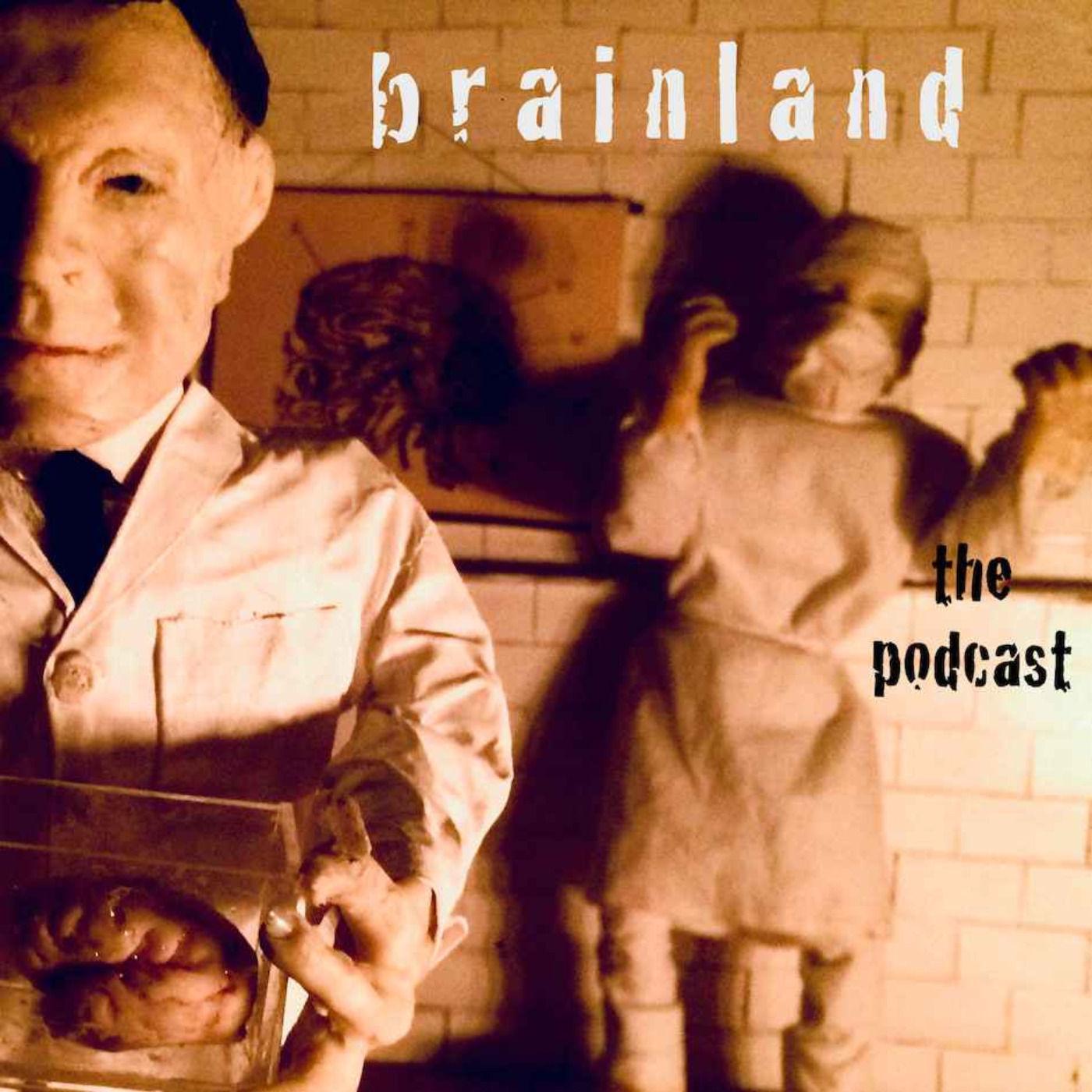
BRAINLAND
Brainland the podcast navigates the boundary between neuroscience, the arts and humanities with the occasional wander off piste. It began as a neuro-historical exploration of the background to the Brainland the opera but quickly spread its wings. A Brainland Collective production. Hosted on Acast. See acast.com/privacy for more information.
Pick up right where you left off
- Resume on any device
- Progress saved on every episode
- Plus every other Pro feature
From €2.49/month
Episodes
THE PROTO-PSYCHOLOGY OF AUGUSTINE (THE AFRICAN).
Nov 24, 2026 · 44m
Resume with ProAugustine of Hippo (later to be sainted) wrote his book 'Confessions' in Latin between AD 397 and 400. Chapter 10, on, memory, is much cited as possibly the earliest account of the psychology of memory. In this wide ranging conversation with Augustine's most recent biographer, who is about to complete her own translation of 'Confessions' we moves from Augustine's world and...
FOLK: Navigating the oldest musical tradition in the 21st century
Nov 17, 2026 · 1h 6m
Resume with ProIn this episode we take a dive into folk, arguably, the earliest musical storytelling. Ben Moss is, in his words, 'a folk singer rooted firmly in the 21st century' but also a multi-instrumentalist who has a new solo EP out, 'Here We Will Dance', and for eight years has toured and recorded with singer song-writer Grace Petrie. Ben talks about his immersion in the folk tradition...
THE ENTREPRENEUR: 'Pattern seeking' in Manchester...
Nov 3, 2026 · 35m
Resume with ProIn this episode property management entrepreneur Will Lewis talks about his early training in surveying/property management and how this led to the creation of a multidisciplinary consultancy when he was 27. He outlines the originality of his business idea and the experience of growing it in Manchester over the last 20 years where number living in the city centre has risen from around a thousand...
THE PROTO-PSYCHOLOGY OF MICHEL DE MONTAIGNE
Oct 13, 2026 · 52m
In this essay, sorry, podcast, Neil Kenny, specialist in French literature and society in the 16th and 17th centuries opens us the period in which Montaigne composed his 'essais', first published in 1580, before talking about the man himself, including his education (he only spoke Latin for the first six years of his life - an educational experiment of his dad). Neil had suggested a...
WIREHEADS: An unatural history of technology and the brain.
Oct 6, 2026 · 44m
In this episode cultural historian Mike Jay shares some of the stories in his new book 'Wireheads'. Our conversation ranges from an eighteenth century Bedlam patient to Elon Musk's 'Neuralink' along the way taking in Havana syndrome and direct energy weapons, the shifting notion of delusion, hoped for effects of electricity on child intelligence, and a variety of doctors who...
PATTERN SEEKING: Autism, evolution and us.
Sep 16, 2026 · 52m
In his book 'The Pattern Seekers' Sir Simon proposes that what has made us successful as a species is our ability to see patterns, 'systemise' and create 'if, then, and' sequences that have enabled us to invent and experiment also and how this ability relates to autism. Our conversation travels from a 40 thousand year old tuned bone flute to creating 'neuro-affirmative' environments in schools...
NEUROMANCER: Cyberpunk at 40.
Sep 4, 2026 · 53m
It is 42 years since the publication of William Gibson's game changing science fiction novel 'Neuromancer' and in 2027 Apple TV's much heralded 10 part adaptation of the novel is being released. In this episode academic Curtis Runstedler references the novel's antecedents, including Burgess's 'A Clockwork Orange' and Ballard's 'The Atrocity Exhibition', but especially Ridley Scott's 1982 film...
THE RATIO CLUB: UK cybernetics powerhouse.
Aug 28, 2026 · 1h 31m
In this special 100th episode of Brainland sometime co-host Andy Platman and Ken talk with Phil Husbands about the 'Ratio Club', a dining club of medics, mathematicians, engineers and physiologists that met regularly between 1949 and 1955 to talk cybernetics. Phil's definitive history of the group is in its final edit. The most well known member was, at the time, Grey Walter, who we talked about...
WHAT HAS GREEK TRAGEDY EVER DONE FOR US?
Aug 14, 2026 · 1h 18m
Did anyone write about human psychology long before there was such a term? Yes and this season we are going to discuss five of them, beginning with three Greek tragedians. 32 of their plays have survived, written almost two and a half thousand years ago and a small sample of a thousand or so performed in the 'golden age' of Greek democracy. After talking though their historical and social...
HUMANISH: The many faces of anthropomorphism
Aug 7, 2026 · 33m
In this conversation, animal behaviourist Justin Gregg talk through the many facets of our species' tendency to attribute human qualities to animals and things, as well as the opposite, to deny human qualities to classes of fellow humans. Our conversation ranges over enthusiasm for dolphin midwives, cuddly sharks and alligators and the difference between dogs and wolves. We talk about the...
EXPLORING THE AUTISTIC BRAIN
Jul 31, 2026 · 48m
In another wide ranging conversation, Prof Rajesh Kana, author of the recent book 'The Neuroscience of Autism' walks us through this potentially complex subject. After definitions we talk about overlaps with other conditions, especially ADHD, and how this is worked with in brain imaging studies. We talk about competing causal hypotheses the varied use of the MRI brain scanner to image structures...
SPEAK! On the neuroscience of language...
Jul 25, 2026 · 43m
In this conversation Jonathan Peelle, language researcher and author of the a recent book on the subject, ranges over many aspects of the brain origins of language. We begin by discussing nineteenth century luminaries Broca and Wernicke and the effect of the First World War on simplistic notions of localisation, revived in modified form by Penfield and Geschwind in the '50s and '60s. We talk...
CHESS MASTERY AND THE ART OF THINKING SIDEWAYS
Jul 20, 2026 · 48m
In this episode expert chess player Jennifer Shahade talks about the world of competitive chess and her motivation for writing her recent book 'Thinking Sideways'. In a wide ranging conversation, we discuss the changes in chess since the events depicted in the TV series 'Queen's Gambit', especially the greater involvement of children, now learning from the age of 4, and also women. We touch on...
THE VISIONARY FICTION OF KAREL ČAPEK
Jul 15, 2026 · 44m
In this episode John Rieder, a leading authority on early science fiction and its critique of colonialism and more talks about Czech writer Karel Čapek, whose play 'RUR', 'Rossums Universal Robots', introduced the word 'robot' to the world. We discuss the way early sci fi, such as Well's 'War of the Worlds', offered a subtle critique of colonialism and uncontrolled profit/capitalism. John...
CHESS HEAD: Could regular chess playing remodel your brain?
Jul 7, 2026 · 1h 5m
In this episode we discuss the history and evolution of chess and how chess competence, up to grand master, is rated, including how this would stand up in a scientific research setting. We talk through the range of brain investigation studies included in their recent review and some of the technical background to those tests and limitations of their methods before moving on to the areas of...
CHALLENGING THE BOUNDARIES OF THE HUMAN: Post-humanism in literature and film
Jun 26, 2026 · 54m
In this episode we explore how post-humanist ideas and perspectives, discussed in the earlier episode with Christine Daigle (season 2, episode 7), are reflected in literature and film. Fresh from teaching a course on post-humanist literature and film, Russ Kilbourn chooses three novels and five films, the former including Mary Shelley's 'Frankenstein' (also discussed in detail at the end of...
FOUND IN TRANSLATION: Linguistic shape-shifting.
Jun 11, 2026 · 44m
In this episode we talk to linguist and academic Nicoletta Asciuto about her York university module 'Found in Translation' and four of her former students. Nicoletta talks about her move from monolingual upbringing to knowledge of ten languages, her decision to teach a module about translating to English from whatever home language. She discusses the often powerful emotional effect of translation...
DERRIDA'S CAT: Exploring the boundaries of the human.
Jun 8, 2026 · 44m
In this episode French philosophy specialist Judith Still talks about Jacque Derrida and in particular his late preoccupation with the animal-human boundary. After surveying philosophical writing on animals going back two millennia, including related views on indigenous peoples, the enslaved and women, Judith talks about the challenges of reading Derrida. We discuss his early life, as a Jewish...
DOPPELGANGER: Doubles in psychiatry, neurology and fiction.
May 19, 2026 · 1h 2m
In this extraordinarily wide ranging podcast, we talk about doubles from the point of view of psychopathology, neuroscience, and what they tell us about the nature of self. Our neuroscience discussion includes the work of Head, Schilder, Damasio (around the idea of body schema/representations in the brain and their implication - a kind of neural double) followed by a fascinating deviation into...
BIOETHICS AND THE NEW WORLD ORDER
May 12, 2026 · 58m
Leading ethicist/philosopher Jonathan D. Moreno makes a welcome return to Brainland to discuss his recently published and compelling book 'ABSOLUTELY ESSENTIAL: Bioethics and the Rules-based Order'. We talk about the history of clinical and bioethic and outline their main components in application to humans. Topics discussed include the Nuremberg trials and why it took 20 years before a consensus...
POSTHUMANIST VULNERABILITY
May 7, 2026 · 48m
In this episode Christine Daigle, a leading figure in posthumanist philosophy and material feminism, begins by defining those terms before unpacking some of the ideas in her recent book 'Posthumanist Vulnerability: An affirmative ethics'. The humanist and Christian traditions both privilege the human, particularly the male human, in the sense of having 'dominion' over the rest of nature and, too...
FREUD AND THE NEUROSCIENCE OF MENTAL HEALING
Apr 30, 2026 · 1h 8m
Mark Solms is a neuroscientist and psychoanalyst fluent in German, which is why in the 1990s, he agreed to take on the daunting task of collating and translating Freud's 23 years of writing on the brain and neurology pre-psychoanalysis. In this episode Marks talks in detail about Freud's early work in neuroscience, and explains how this transitioned into his theories of the mind and how to help...
PROTO: Uncovering the shared origin of the world's most spoken languages.
Apr 21, 2026 · 42m
In this episode Laura Spinney talks about the background to her book 'Proto', an extraordinarily wide ranging and engaging account of the origin and archeology of Indo-European languages. We discuss the source of ancient DNA that is uncovering the extraordinary migration west of nomads from the Ukranian and Russian steppe along with their language, the ancestor of the most spoken languages in the...
GEORGE SAND: The life, times and shifting reputation of an early feminist writer and thinker.
Apr 2, 2026 · 59m
In this podcast we discuss 19th century French novelist, dramatist and memoirist George Sand. In a wide-ranging conversation, based on Fiona's very readable and recent biography, we talk about Sand's great literary success in an era in which she was a political progressive abolitionist, early feminist and even ecologist. Her unusual origins, unhappy marriage, rapid literary success and famous...
TRANSHUMANISM: Humanity's great hope or the devil's work?
Mar 24, 2026 · 50m
In this episode Stefan Sorgner, a leading academic in the growing field of transhumanist philosophy defines and talks about his route to the subject before drawing a distinction, elaborated in his upcoming book, on the difference between 'classical' and 'Euro' varieties. He stresses that, in a sense, we have been augmented humans ('cyborgs'), since we acquired the ability to create and use...