
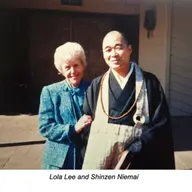
Talks by Zen Roshi, Lola McDowell Lee
This is a series of newly digitized talks by spiritual teacher, Lola McDowell Lee, spanning two decades—from the early Seventies through the Nineties. Lola was a Zen Roshi whose Rinzai lineage included Doctor Henry Platov and renowned Zen master, Shigetsu Sasaki. Lola was a religious scholar as well as an ordained Christian minister. While the talks are focused mainly on Zen and Buddhism, Lola drew on many spiritual traditions—including those of Jesus, Plato, Lao-Tzu, the Hindu Vedas, Meister Eckhart and Gurdjieff. If you find Lola’s talks valuable, more will be posted in days to come. RSSVERIFY
Pick up right where you left off
- Resume on any device
- Progress saved on every episode
- Plus every other Pro feature
From €2.49/month
Episodes
The similarities between Hassidic Judaism and Buddhism. May 19, 1985
Oct 9, 2024 · 58m
Resume with ProZen Roshi, Lola McDowell Lee, discusses the similarities between Hasidic Judaism and Buddhism. Many religions are more emotional. Zen practitioners are often intellectual. The similarities between Hasidic Judaism and Buddhism. Also, the tale of two men who travel during a dark night. Only one has a lantern. When their paths split, the man without the lantern must grope along in the darkness. That...
Make the smallest distinction and heaven and earth are set infinitely apart. May 12, 1985
Sep 29, 2024 · 51m
Resume with ProZen Roshi, Lola McDowell Lee, explores the notion of preferences. As the Third Chinese Patriarch of Zen put it: when love and hate are both absent, everything becomes clear and undisguised. Make the smallest distinction, however, and heaven and earth are set infinitely apart. If you wish to see the truth, then hold no opinions for, or against, anything. That is the choice-less reality, true...
A monk asked his teacher, "I am pecking from inside the shell. I beg you, Master, please peck from outside." May 5, 1985
Sep 23, 2024 · 53m
Resume with ProZen Roshi, Lola McDowell Lee, explains that when most of us listen to a teacher talk, what we hear is determined by our conditioning. When one talks to God in his thoughts, he is not talking to God. To truly practice, one must be wholly sincere and not deceive oneself. A monk came to a Zen Master and asked, ”What if you meet up with someone who is deaf, dumb, and blind?” Also, if the aim of a Zen...
First is learning, called hearing. Then approaching. Then transcending. Lola Apr 14, 1985
Sep 19, 2024 · 52m
During this talk, Zen Roshi, Lola McDowell Lee, has a bad cough, which she lightheartedly uses in her discussion about how to hear and how to listen. To listen like a tape recorder, without thinking. Lola walks us through a quick history of philosophical thinking, from the Ionians (Thales thought the basic entity was water) to Pythagoras to Aristotle and beyond. To discipline oneself in learning...
As illusions drop, as attitudes drop, how relaxing it is to be at ease with yourself. Mar 31, 1985
Sep 13, 2024 · 51m
You are born into pleasure and pain, and eventually emotions develop. Then centuries of conditioning. From your parents, from your culture. How many personalities and faces do you have? All creating contradictions in you. But if you dig down, there is unity—an undivided, centered individual. Most important: do not deceive yourself. Sit. Look into yourself and the truth will reveal itself to you...
The depth in saying “I don’t know.” Mystica Theologica. Lola Jul 22, 1985
Sep 4, 2024 · 48m
Zen Roshi, Lola McDowell Lee, discusses Mystica Theologica by St Dionysias. He said religious experience can’t be described. Like music: as much as you might name notes, no description is adequate to explain what music really is. So it is with religious experience. Dionysias called it “agnosia” or unknowing. There is a depth in saying “I don’t know.” Even Socrates said the only thing he knows is...
Zen masters never tell the truth. July 15, 1985
Aug 26, 2024 · 54m
Zen Roshi, Lola McDowell Lee, recounts the tale of Zen Master Hogen who studied with Keishin Zenji. Once Keishin Zenji asked him, 'Joza, where do you go?' “Hogen answered, 'I am making pilgrimage aimlessly." Lola also shares the story of the non-believer who falls off a cliff and dangles by a small twig. He begs God to help him. "But I thought you didn’t believe in me,” says God. The non-believer...
"The mind dwells in the cave of the heart. He who conquers it frees himself from slavery." May 26, 1985
Aug 15, 2024 · 59m
Zen Roshi, Lola McDowell Lee, explains how you can ask questions about the meaning of life all day long. But who is the questioner? Usually we take the wrong approach to these questions. The questions and the answers are thoughts—or objects. They are not reality. If you have a deluded mind, how are you supposed to use it in meditation? You must set it aside. When silence is present, where are...
The mightiest fighting rooster does not crow about his might. Jun 24, 1984
Aug 14, 2024 · 39m
Zen Roshi, Lola McDowell Lee, shares the teachings of Lao Tzu. He was not a brave man. Or a coward. Courage does not play a role in the sage. The mightiest fighting rooster does not crow about his might. True confidence does not brag. If you meet a sage on the road, how do you greet him? Meditation is like a coiled spring. You push, push, push it down… then release. Jun 24, 1984
When you’re silent, there is one mind. When you’re thinking, you are many. Jun 10, 1984
Aug 6, 2024 · 51m
Zen Roshi, Lola McDowell Lee, explains how a mirror reflects everything before it. It reflects young you when you’re young. It reflects old you when you’re old. But the mirror isn’t old or young. It is uncontaminated. The same consciousness is watching from inside you when you’re young, when you’re middle aged and when you’re old. But that Witness isn’t young or middle aged or old. Just like the...
Examine your past so it doesn’t govern you. The past is dead. Stop living it. Oct 30, 1983
Jul 30, 2024 · 52m
Zen Roshi, Lola McDowell Lee, explains how when you’re happy, sad, pleased, unpleased—it’s all in your periphery. It is not really you. When you’re happy, sad, pleased, displeased—it’s all in your periphery. It is not really you. Do not deceive yourself with your own attitudes. Plastic flowers do not grow. Plastic personas do not grow. But you can. Your appearances give you respectability but...
What must wake up in you for you to be awake? Oct 29, 1989
Jul 25, 2024 · 51m
Zen Roshi, Lola McDowell Lee, explores the wisdom of Zen Master Ikkyu. What must wake up in you for you to be awake? Where do you go when you’re in a deep sleep? Buddhism is a religion of the individual. We become individually free. Teaching about awakened self is like selling water by the river. We spend our lives trying to make our fantasies a reality. Assuming responsibility for one’s...
Once we understand we are not the masters of our thoughts—but victims—we can stop cooperating. Lola Mar 17, 1985
Jul 15, 2024 · 58m
Zen Roshi, Lola McDowell Lee, recounts tales of Master Fugai. Lola gives a detailed explanation of meditation. How the word meditation, historically, has been thought to mean thinking, pondering. But in Zen it’s just the opposite. In Zen meditation you sit, and can watch your thoughts go by, but you do not get swept up by them. If you observe closely you’ll start to see that your thoughts create...
The tale of the visitor who asked Zen master Bankei what miracles he could perform. Aug 6, 1989
Jul 11, 2024 · 58m
Zen Roshi, Lola McDowell Lee, discusses how we’re all waiting for the most extraordinary teacher. We want only the best. The tale of the visitor who asked Zen master Bankei what miracles he could perform. His answer is lovely Zen. Lola lso, understanding the concept of “don’t know.” It’s very difficult. We all prefer to be clever, which obscures our original mind. If you recognize the original...
Easter of 1985 - What Zen practitioners can learn from the story of Christ's Resurrection. Apr 7, 1985
Jul 2, 2024 · 50m
Zen Roshi and ordained Christian minister, Lola McDowell Lee, gives this talk during Easter of 1985. She explores the Resurrection of Christ. You can experience the Resurrection yourself. Your deathless existence is within you. It is the Godseed. The tale of the king who leaves his three sons each a bag of seed and asks them to best preserve them in his absence. The seed must die in order to...
Second in a series about using Transactional Analysis in Zen - the Child, Parent, Adult. Lola Oct 13, 1983
Jun 24, 2024 · 49m
Zen Roshi, Lola McDoweel Lee, explains how we all call ourselves an I, but there is only one—which everyone appropriates for themselves. Eventually our thoughts, voices, identifications eclipse the I. We adopt styles from lots of people—actors, ministers, anyone who appeals to us. The second in a series about the Transactional Analysis approach of Child, Parent, Adult. Child enjoys the moment...
Learning to work with three elements of our identity: the parent, the child and the adult. Oct 6, 1983
Jun 17, 2024 · 49m
Zen Roshi, Lola McDowell Lee, explains three parts of our psychology working against each other --the parent, the child and the adult. The child’s impulses and emotions shouldn’t be in control. The parent alone can be dominating.The adult hold to reason only, which can make for a flat life. Some part will be dissatisfied. Ideally, we become a part of all three. The Buddha doesn’t choose one. He...
Most of us are after power. Control in our situation. A wiseman seeks not. Instead, he cooperates. Nov 27, 1923
Jun 11, 2024 · 43m
Zen Roshi, Lola McDowell Lee, explains how most of us are after power—control, authority in our situation. A wise man seeks not. Instead, he cooperates, harmonizes with the situation. The tale of Frederick The Great of Prussia’s solution to the many sparrows eating his kingdom's grain. Cleansing your mind is not a one-time effort. Because each day you gather more dust. So Lola suggests you...
Life. Death. And Love. The most important thing for you is your life. Do you ever thoroughly investigate it? Nov 20, 1983
Jun 9, 2024 · 1h 0m
Zen Roshi, Lola McDowell Lee, discusses Love, Life and Death. When you are filled with love, there is nothing missing. Can you love without a lover? Some people share their loneliness and call it love. The most important thing for you is your life. Yet most of us never thoroughly investigate it. In deep meditation you can. Death is an unpopular subject All you think you are now is going to die...
We can repeat the most profound teachings and remain stupid. What in us is orginal? May 1, 1983
May 23, 2024 · 48m
Understanding the noetic quality of mind, the hidden self, through meditation. That is just a matter of sitting, and being who you are. The difference between sailing on a paper boat and a real boat: How we think about what enlightenment will be. And being it firsthand. Many of us parrot what we know from things we’ve heard or read. We can repeat the most profound teachings and remain stupid...
Get beyond the effort of meditation and find real meditation. Jul 3, 1983
May 17, 2024 · 57m
Zen Roshi, Lola McDowell Lee, asks: When you are alone… are you really alone? We treat the ego as an absolute, when, in fact, it is a gap between you and totality. Ask yourself: Who am I? And you’ll find the Buddha. What does a Zen teacher do? Beyond aloneness and togetherness is the eternal — no one going nowhere. Non-dualistic wisdom. Remain in the Witness your whole life. It’ll change things...
The Taoist sage, Lieh Tzu, was once asked: Why do you value emptiness? Jun 12, 1983
Apr 20, 2024 · 57m
Zen Roshi, Lola McDowell Lee, explains how existence is reported to us as separate objects. But there is a unity to life that runs through everything—called the Tao. The Taoist sage, Lieh Tzu, was once asked: Why do you value emptiness? His answer is explained. Also, most spiritual paths fall into two categories: via affirmative and via negativa. The affirmative path is where we take actions to...
What is the greatest miracle in the world? Oct 30, 1983
May 7, 2024 · 52m
Zen Roshi, Lola McDowell Lee, explores how it is In the other that we see what we think is us. When we are alone, many of us feel in strange company. It’s possible to see what one’s life is really about. The thoughts out there, which have have become a mask to our true selves, will grow dimmer. Until our spiritual search is no longer just a curiosity or inquiry—but becomes a deep hunger that...
By the merit of a single sitting, they destroy innumerable sins. (Hakuin) Jun 5, 1983
Apr 10, 2024 · 50m
Zen Roshi, Lola McDowell Lee, recounts the tale of a teacher’s interaction with his student, Hakuin, who became the founder of Rinzai. From Hakuin’s “Song Of Meditation” we hear: “All beings are from the very beginning Buddhas. It is like water and ice: apart from water, no ice. Outside living beings, no Buddhas. Not knowing it is near, they seek it afar. What a pity!” Jun 5, 1983
There are plenty of Buddha statues sitting still. But have you ever seen a Zen master sitting still? Mind vs action. May 29, 1983
Apr 2, 2024 · 53m
Zen Roshi, Lola McDowell Lee, asks: What are you searching for? Do you know it is your ego that is doing the searching? You see plenty of Buddha statues sitting still. But have you ever seen a Zen master sitting still? They are always doing something. There is silence and there is action. The mind and the body. We have both. And we need both to understand. We need to learn how to bring ourselves...