
Sudoku Encyclopedia Podcast
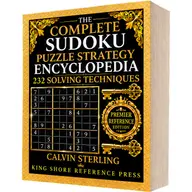
Welcome to The Sudoku Encyclopedia Podcast, the show where we take Sudoku solving strategies one at a time and break them down in plain language, so you can use them in your very next puzzle. Sudoku strategies covered in the podcast episodes: Category 1: Foundations, Singles, Intersections & Subsets [14 Solving Techniques]: Full House / Last Digit, Naked Single, Hidden Single, Locked Candidates Type 1, Locked Candidates Type 2, Naked Pair, Hidden Pair, Naked Triple, Hidden Triple, Naked Quad, Hidden Quad, Locked Pair, Locked Triple, Almost Locked Candidates Category 2: Basic Fish & Single-Digit Geometry [24 Solving Techniques]: X-Wing, Swordfish, Jellyfish, Squirmbag, Whale, Leviathan, Finned X-Wing, Finned Swordfish, Finned Jellyfish, Finned Squirmbag, Finned Whale, Finned Leviathan, Sashimi X-Wing, Sashimi Swordfish, Sashimi Jellyfish, Sashimi Squirmbag, Sashimi Whale, Sashimi Leviathan, Skyscraper, Two-String Kite, Crane, Empty Rectangle, Rectangle Elimination, Extended Rectangle Elimination Category 3: Advanced Fish & Hybrid Single-Digit Patterns [17 Solving Techniques]: Endo-Finned Fish, Cannibalistic Fish, Siamese Fish, Franken Fish, Finned Franken Fish, Sashimi Franken Fish, Mutant Fish, Finned Mutant Fish, Sashimi Mutant Fish, Kraken X-Wing, Kraken Swordfish, Kraken Jellyfish, Kraken Franken Fish, Kraken Mutant Fish, Multi-Fish, Grouped Fish, Almost Fish Category 4: Wings, Bent Sets & Short Bivalue Patterns [24 Solving Techniques]: XY-Wing, XYZ-Wing, W-Wing, M-Wing, S-Wing, L-Wing, H-Wing, T-Wing, ER-Wing, WXYZ-Wing, WXYZ-Wing Type 2, VWXYZ-Wing, UVWXYZ-Wing, TUVWXYZ-Wing, Remote Pairs, Almost Remote Pair, Remote Triplet, Chute Remote Pairs, XY-Chain, XY-Cycle, Twinned XY-Chains, Fireworks, Triple Firework, Quadruple Firework Category 5: Coloring, X-Chains & Candidate Networks [14 Solving Techniques]: Simple Coloring, Multi-Colors, Weak Colors, X-Colors, 3D Medusa, Equivalence Marks, Graded Equivalence Marks, X-Chain, Grouped X-Chain, X-Cycle, Grouped X-Cycle, Broken Wing, Oddagon Forcing Chain, Single Implication Network Category 6: Uniqueness & Deadly-Pattern Logic [28 Solving Techniques]: Unique Rectangle Type 1, Unique Rectangle Type 2, Unique Rectangle Type 2B, Unique Rectangle Type 2D, Unique Rectangle Type 3, Unique Rectangle Type 3B, Unique Rectangle Type 4, Unique Rectangle Type 4B, Unique Rectangle Type 5, Hidden Unique Rectangle Type 1, Hidden Unique Rectangle Type 2, Hidden Unique Rectangle Type 2B, Extended Unique Rectangle, Unique Rectangle with Missing Candidates, Avoidable Rectangle, Higher-Order Avoidable Rectangle, Unique Loop, Unique Polygon Type 1, Unique Polygon Type 2, BUG+1, BUG+2, BUG+3, BUG+4, BUG Lite, Reverse BUG, Reverse BUG Lite, Uniqueness Clue Cover, Gurth's Symmetrical Placement Category 7: AICs, Nice Loops & General Chains [20 Solving Techniques]: Alternating Inference Chain, Grouped AIC, AIC with ALS Nodes, AIC with Unique-Rectangle Links, AIC with Exotic Links, Continuous Nice Loop, Discontinuous Nice Loop, Grouped Nice Loop, Double Implication Chain, xyt-Chain, xyz-Chain, xyzt-Chain, Hidden xyt-Chain, Hidden xyz-Chain, Hidden xyzt-Chain, NRC-Chain, NRCT-Chain, NRCZ-Chain, NRCZT-Chain, Bivalue Chain Category 8: ALS, Set-Link & Exclusion Logic [27 Solving Techniques]: ALS-XZ, ALS-XZ Double Link, ALS-XY-Wing, ALS-XY-Chain, ALS-W-Wing, ALS Chain, Death Blossom, Almost Locked Pair, Almost Locked Triple, Almost ALS, Combined Overlapping ALS Rule, Almost Hidden Set, Almost Naked Set, Bent Almost Restricted Naked Set, Multi-Sector Locked Set, Multi-Sector Naked Set, Multi-Sector Hidden Set, Disjointed Distributed Subset, Almost Disjointed Distributed Subset, Quantum Naked Set, Pseudo-Naked Set, Sue de Coq, Aligned Pair Exclusion, Aligned Triple Exclusion, Subset Exclusion, Subset Counting, Constraint Subsets Category 9: Exotic Static Patterns, Templates & Exocets [21 Solving Techniques]: Pattern Overlay Method, Braid Analysis, N-Rope, N-Braid, Z-Rope, Z-Braid, SK Loop, Tridagon, Exocet, Junior Exocet, Senior Exocet, Double Exocet, Generic / Generalized Exocet, Almost Generic Exocet, Generalized Exocet with Aligned Targets, Phistomefel Ring, Set Equivalence Theory, Set Link Graphs, Domino Loop, Virus Loop, Incompatible Quads Category 10: Forcing, Enumeration & Formal Resolution Systems [43 Solving Techniques]: Nishio Forcing Chain, Digit Forcing Chain, Cell Forcing Chain, Dual Cell Forcing Chain, Triple Cell Forcing Chain, Quad Cell Forcing Chain, Unit / Region Forcing Chain, Contradiction Forcing Chain, Dynamic Forcing Chain, Double Forcing Chain, Multiple Forcing Chain, Forcing Net, Cell Forcing Net, Region Forcing Net, Dynamic Forcing Net, Nested Forcing Chain, Nested Forcing Net, Bowman's Bingo, Tabling, Trial and Error, Bifurcation, Backtracking, Brute Force, Z-Chain, t-Whip, Whip, Braid, Generalized Bivalue Chain, Generalized Whip, Generalized Braid, Forcing Whip, Forcing Generalized Whip, Forcing Braid, Forcing Generalized Braid, W-Whip, B-Braid, Technique of Tracks, Triangular Matrix, Block Triangular Matrix, Mixed Block Matrix, Pigeonhole Matrix, Forbidding Matrix, Symmetric Pigeonhole Matrix
Pick up right where you left off
- Resume on any device
- Progress saved on every episode
- Plus every other Pro feature
From €2.49/month
Episodes
Sudoku Strategy 5: Claiming (Locked Candidates Type 2) Explained
Nov 26, 2026 · 8m
Resume with ProGo to https://mybook.to/SudokuEncyclopedia to learn all 232 Sudoku strategies perfectly with this Sudoku encyclopedia. One row can clear a digit from the rest of a box. That's Claiming, Sudoku Strategy 5, also called Locked Candidates Type 2. WHAT IT MEANS Claiming starts from a row or column. If every spot for one digit on that line sits inside a single 3×3 box, that box has to get the digit...
Sudoku Strategy 4: Pointing (Locked Candidates Type 1) Explained
Nov 25, 2026 · 8m
Resume with ProGo to https://mybook.to/SudokuEncyclopedia to learn all 232 Sudoku strategies perfectly with this Sudoku encyclopedia. Strategy 4 of 232: Locked Candidates Type 1, also called Pointing. It's the next move to learn after Full House, Naked Single and Hidden Single. THE RULE Pick one 3x3 box and one digit. If every spot for that digit inside the box lines up on a single row or column, the digit must...
Sudoku Strategy 3 - Hidden Single
Nov 24, 2026 · 9m
Resume with ProGo to https://mybook.to/SudokuEncyclopedia to learn all 232 Sudoku strategies perfectly with this Sudoku encyclopedia. Hidden Single: When a digit has only one legal spot in a row, column, or box, it must go there, even if that cell still shows other candidates. How to spot it: 1. Choose one house (a row, column, or box) 2. Follow one missing digit through every unsolved cell 3. If it fits in...
Sudoku Strategy 2 - Naked Single
Nov 23, 2026 · 10m
Go to https://mybook.to/SudokuEncyclopedia to learn all 232 Sudoku strategies perfectly with this Sudoku encyclopedia. A Naked Single is an empty cell that has exactly one candidate left. Every other digit has been ruled out, usually because it already appears somewhere among that cell's peers. When only one digit survives, that digit has to go in the cell. It's called naked because nothing is...
Sudoku Strategy 1 - Full House
Nov 22, 2026 · 10m
Go to https://mybook.to/SudokuEncyclopedia to learn all 232 Sudoku strategies perfectly with this Sudoku encyclopedia. A Full House happens when a house has exactly one empty cell left. The other eight cells are already filled, so eight of the nine digits are already accounted for. That leaves one missing digit and one open cell to hold it. The missing digit goes in that last cell, and that's the...